You reach for the small saucepan and the whole stack slides with a crash. The lid you need sits three pans down, and the pan you find belongs to a different pot. Most of us have lived this cabinet at least once.
The trouble is rarely too much cookware. Pots and pans are heavy and oddly shaped, so they end up stacked in the first open spot. Lids slide off, handles catch, and the pan you want hides at the bottom of the pile.
These pots and pans storage ideas fix that in different ways. Some need a drill and a free afternoon, while others need only a tension rod or a low cost rack. This guide from Dreamy Decor Ideas covers renters, tiny kitchens, and awkward corners, with notes on keeping heavy cookware low. Pick the one that fits. For more room ideas, see our kitchen ideas.
In this article
- 1. Turn a Roomy Drawer Into a Pan Drawer With Adjustable Peg Dividers
- 2. Stand Pans Upright in a Cabinet With a Vertical Divider Rack
- 3. Add a Pull-Out Shelf So Nothing Gets Lost at the Back of the Cabinet
- 4. Hang Everyday Pots on a Wall Rail Anchored Into Studs
- 5. Hang Pots From a Ceiling Rack Over the Island
- 6. Keep Lids on the Inside of a Cabinet Door
- 7. Cover a Blank Wall With a Pegboard Cookware Wall
- 8. Fix the Dead Corner With a Swing-Out or Lazy Susan Shelf
- 9. Store Your Heaviest Cookware in Under-Island Drawers
- 10. Keep the Pots You Use Daily on Open Shelves Near the Stove
- 11. Slide a Narrow Pull-Out Rack Into That Skinny Cabinet
- 12. Give Cookware Its Own Shelf in the Pantry
- 13. Add a Freestanding Shelf When Cabinets Run Out
- 14. Use Tension Rods to Make Lid and Pan Slots Inside a Cabinet
- 15. Set Up a Pots and Pans Storage Zone Next to the Stove
- How to Choose the Right Pots and Pans Storage for Your Kitchen
- Pots and Pans Storage Ideas: Common Questions
- A Calmer Cabinet Starts Small
1. Turn a Roomy Drawer Into a Pan Drawer With Adjustable Peg Dividers
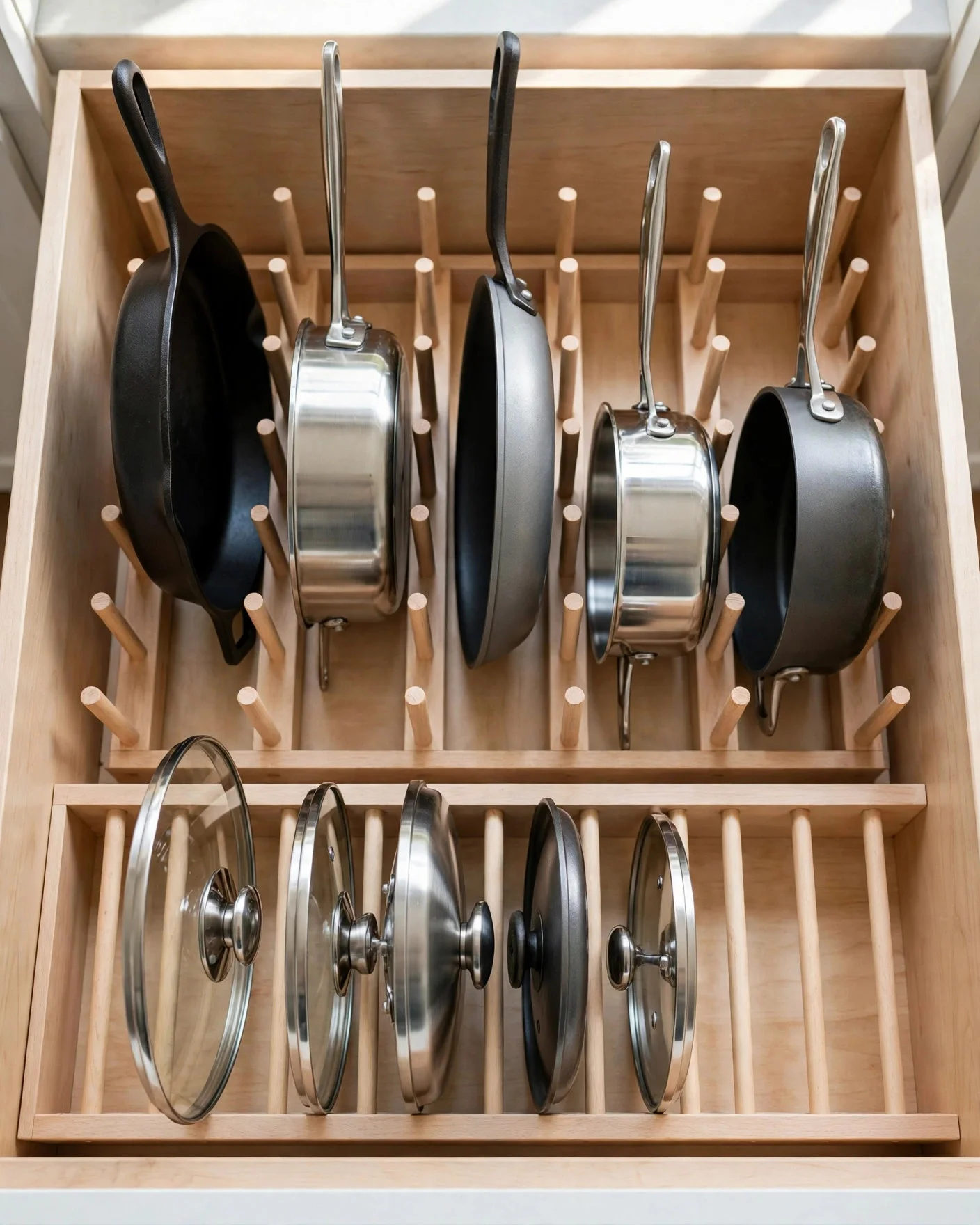
A roomy drawer is the easiest place to keep a full set of cookware. Movable pegs let you set each pan on its edge in its own slot, so you see every handle at a glance. Nothing stacks, so nothing scratches. A thin liner under the pegs stops the pans from sliding when you open the drawer fast.
- Biggest skillet at the back.
- Saucepans in the middle.
- Lids upright in a slotted rack at the front.
Measure your widest pan first, so the slots leave room for it. This is one of the simplest pots and pans storage ideas for a drawer that already holds too much, and it costs less than a new cabinet.
Cost: Medium.
Effort: One afternoon.
Fits: Wide, roomy drawers.
2. Stand Pans Upright in a Cabinet With a Vertical Divider Rack
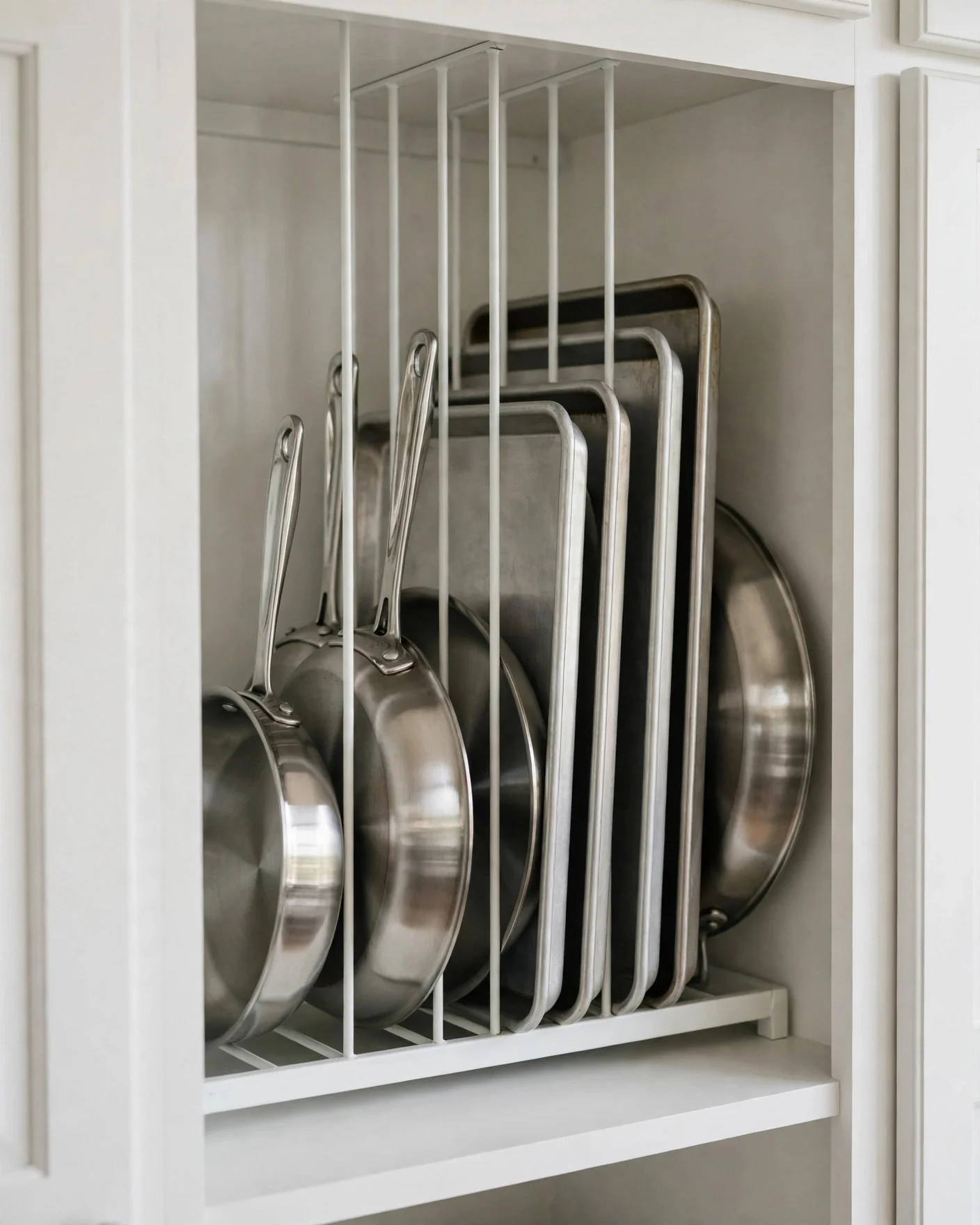
Stacking is not the only way to keep a pan. A vertical divider rack holds skillets and baking sheets on their edges, like files in a cabinet. You slide out the one you want and the rest stay put. Most racks sit on the cabinet floor, so nothing gets screwed into the walls. That makes it a safe pick for renters and small kitchens.
Check the slot spacing before you buy. Thick cast iron needs wider gaps than thin nonstick pans, and a rack that is too tight can chip a coating. For more small space storage, see our tiny studio apartment storage hacks. These pots and pans storage ideas work best when each pan has its own slot.
Quick tip: Lay a strip of felt or a thin rubber liner on the cabinet floor under the rack. It keeps the rack from creeping forward and quiets the clank when you lift a pan out.
3. Add a Pull-Out Shelf So Nothing Gets Lost at the Back of the Cabinet
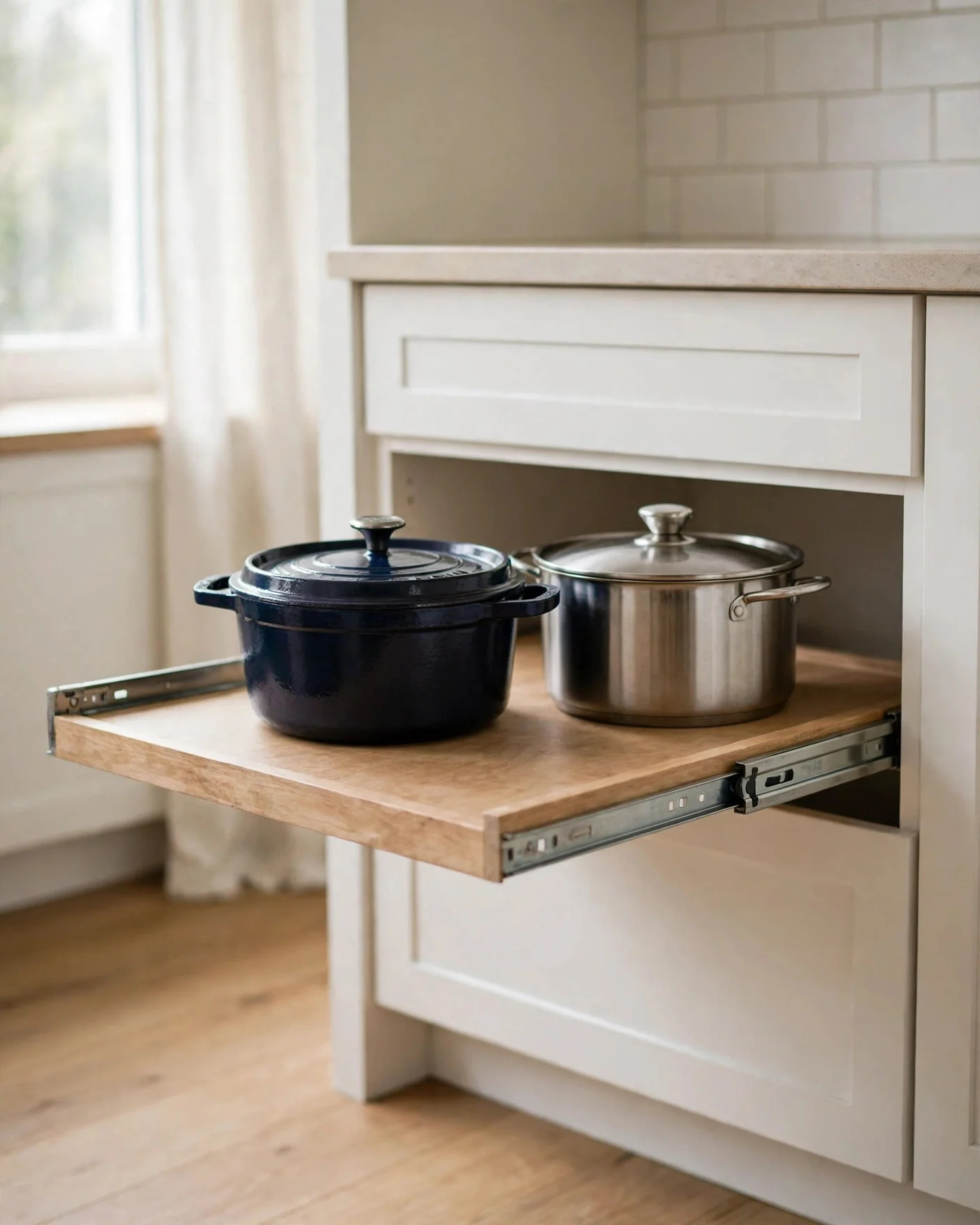
The Dutch oven lives at the back of the bottom shelf, and the only way to reach it is on your knees with a phone flashlight. A pull-out shelf fixes that. It rides on rails, so the whole shelf glides forward and the back of the cabinet comes to you. Some versions screw into the cabinet floor, while others slide in loose with no tools at all.
Look at the weight rating before you buy, and compare it with your heaviest pot, lid included. Heavy pieces belong on the lowest shelf, never up high. A shelf that glides smooth saves your knees and your patience in equal measure, which is why this ranks among the handiest pots and pans storage ideas for a cabinet you use every day.
Before: Pots stacked three high, lids on top, and the Dutch oven buried behind everything.
After: Each pot sits in a single layer on a shelf that slides out. You see every piece and lift nothing over anything else.
4. Hang Everyday Pots on a Wall Rail Anchored Into Studs
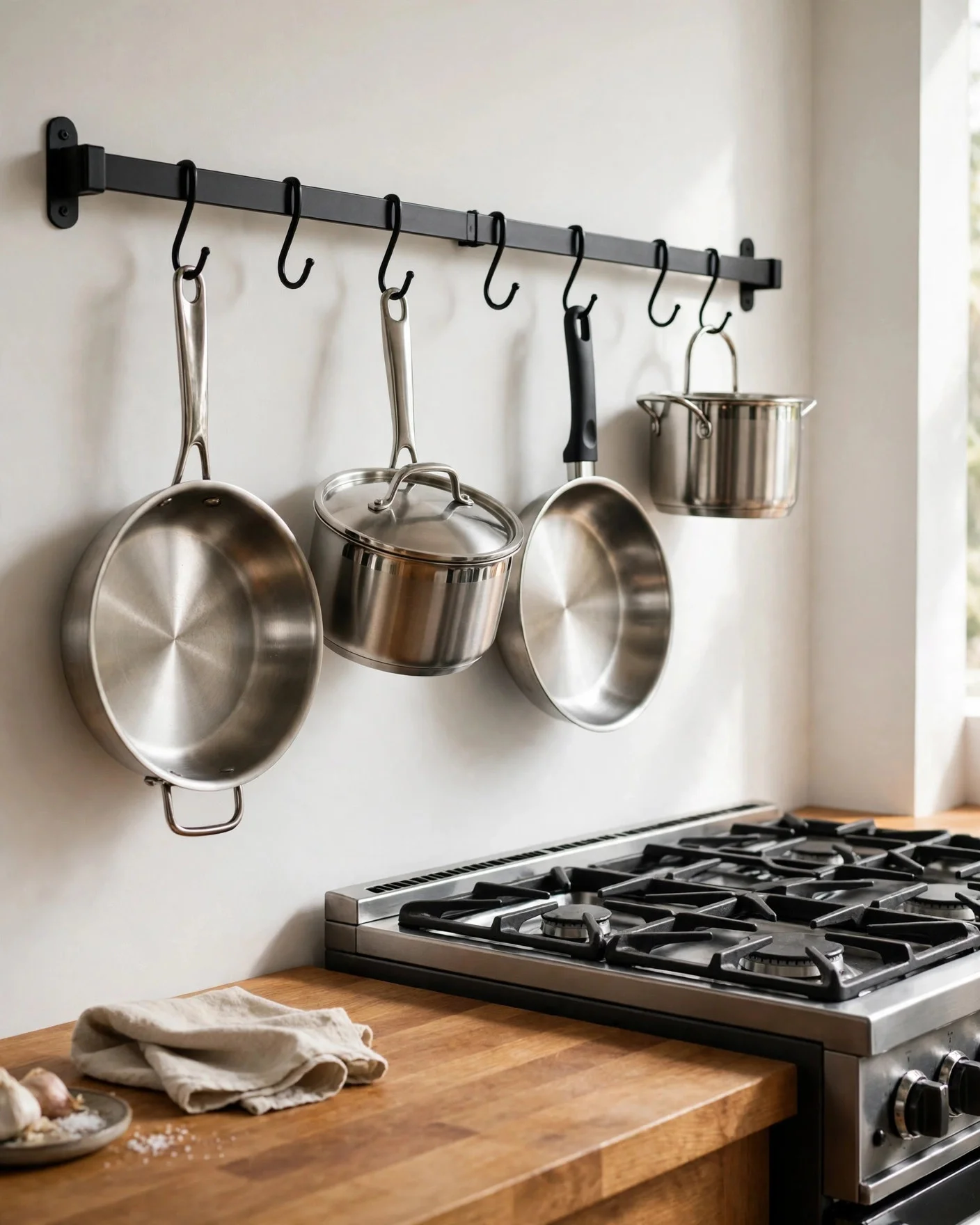
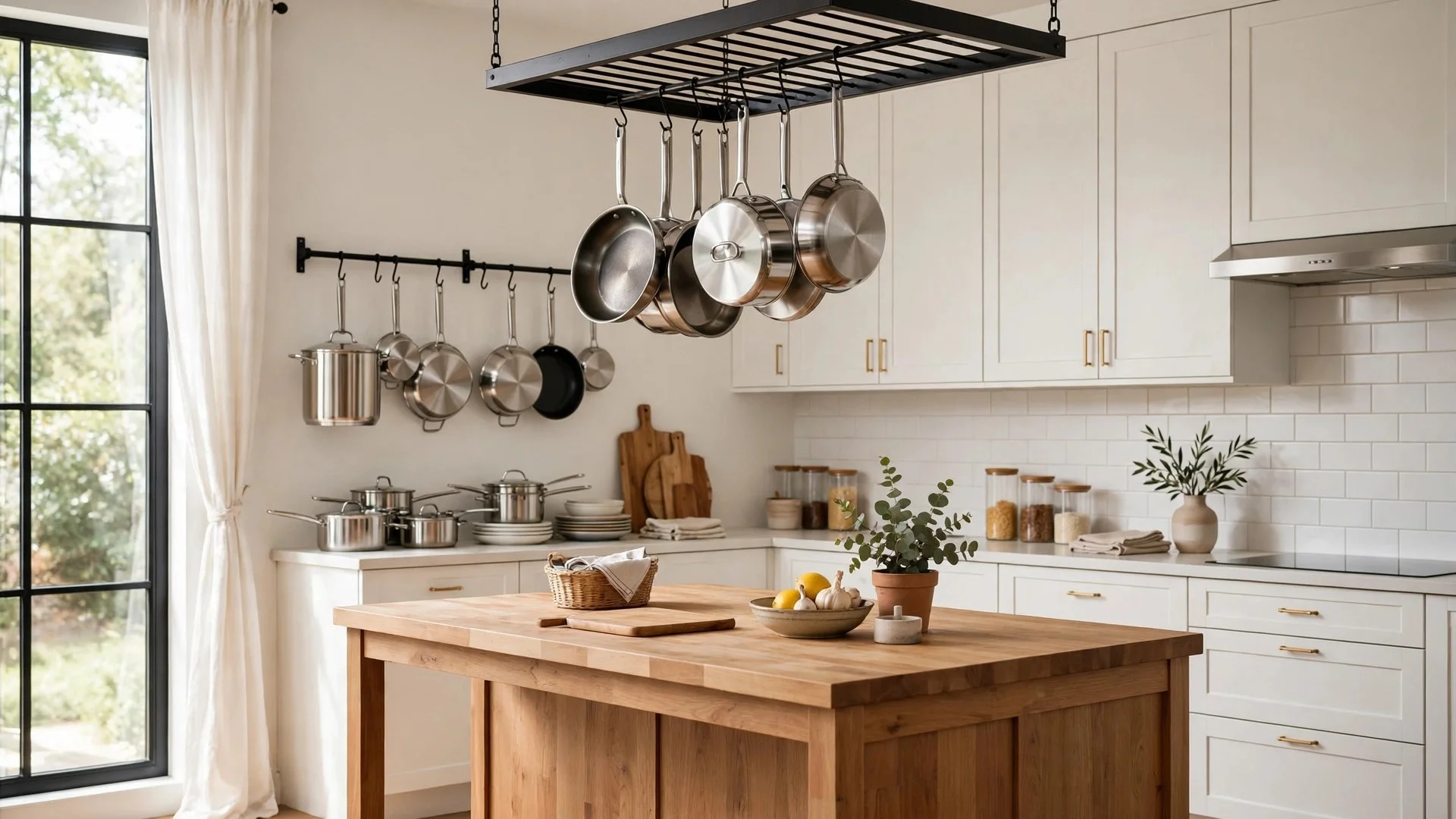
Find the studs first, then pick the rail. A wall rail with hooks holds the pots you grab every day, and it frees up a whole shelf in a small kitchen. Hang the skillet and main saucepan you use most, and leave the heavy stockpot in a low cabinet.
Cookware adds up fast, and screwing a rail into drywall alone is how racks end up on the floor. Use a stud finder and drive the screws into studs. Use heavy duty anchors only where there is no stud, and only if the hardware is rated for the load. Renters should check with the landlord before they drill.
Confirm before you drill:
- The rail and hooks are rated for the combined weight of everything you plan to hang.
- Every screw reaches into a stud.
- The height lets you lift a pot off without reaching or straining.
- The wall is not directly behind a burner, where grease and heat build up.
5. Hang Pots From a Ceiling Rack Over the Island
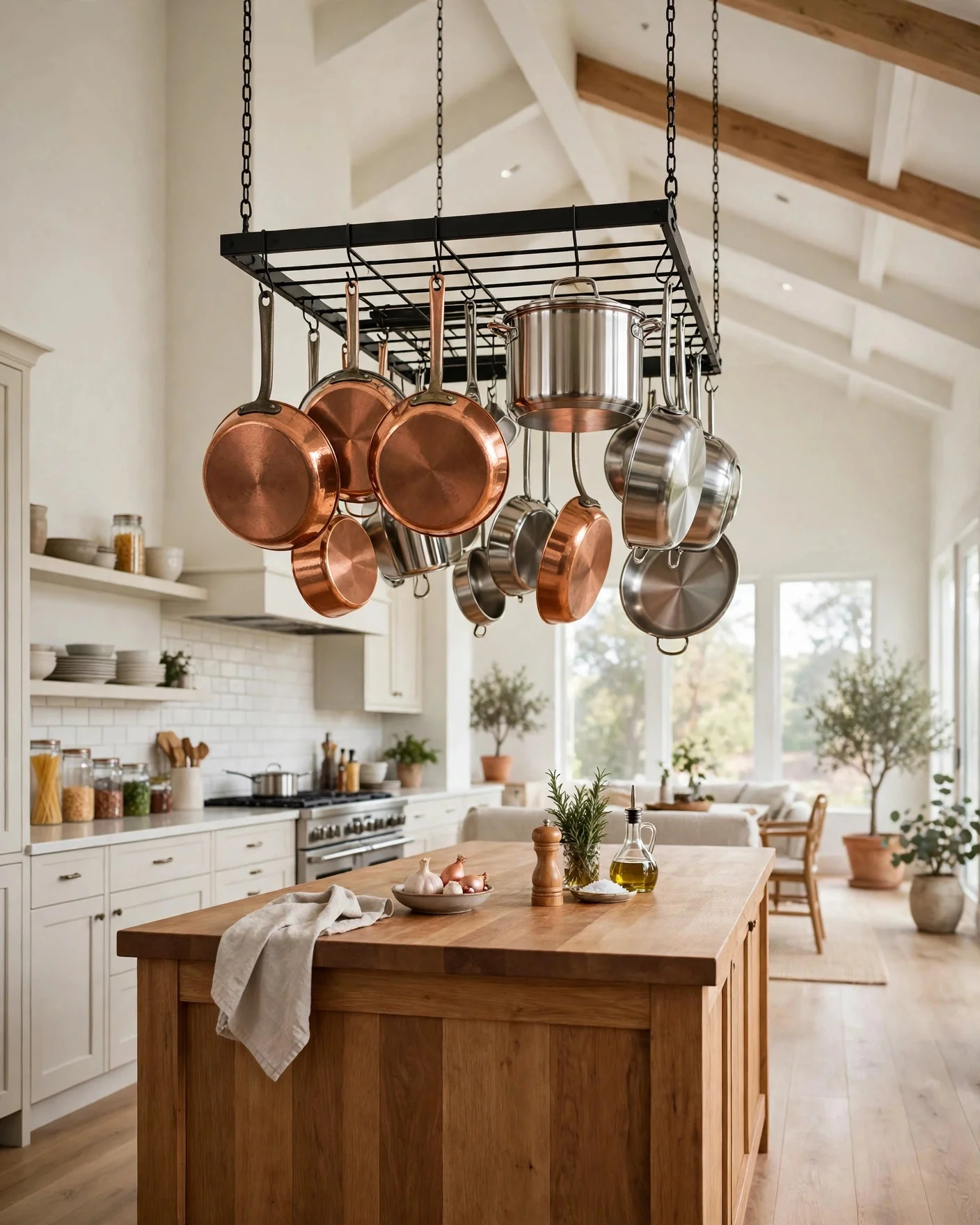
A hanging rack over the island puts your pots right where you cook. It works best in open layouts with enough ceiling height that nobody bumps their head. Hang it so the lowest pot clears the tallest person in the house, and keep it away from the cooktop so grease does not coat everything.
The big job is the mounting. Ceiling racks need bolts into joists, not just drywall, and a rack with a full load of cookware gets heavy fast. If you are not sure where the joists run, ask a pro to install it. Open plan kitchens suit this best, and our living room ideas show how the same open space can stay calm and tidy. Few pots and pans storage ideas free up as much shelf space as a rack that uses the ceiling.
The one thing to remember: Mount into joists, and add up the weight of every pot before you hang the first hook.
6. Keep Lids on the Inside of a Cabinet Door
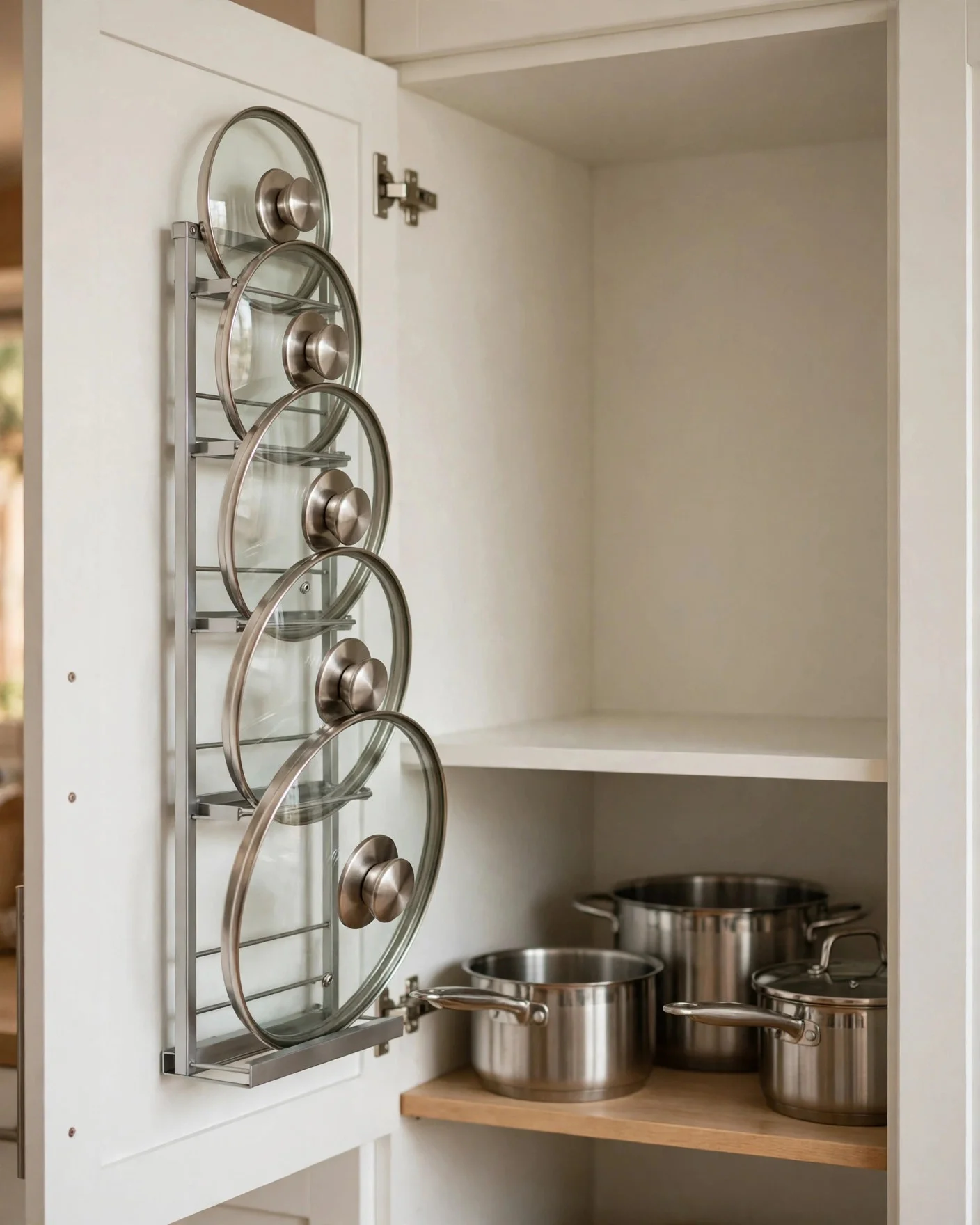
Lids are the one piece of cookware that never stays put. They slide off pots, hide under pans, and slip down the back of a shelf. The inside of a cabinet door is empty space that most kitchens ignore. A slim rack gives every lid its own slot and frees the shelf below for pots. It is a low cost move, and it works in the smallest kitchens.
Light lids are fine on most doors. A full set of heavy glass lids may strain a thin one, so check the door first and keep the heaviest lids on a shelf.
- Open the door and measure the clear space between it and the nearest shelf or pot.
- Choose a rack that hooks over the top of the door if you cannot drill, or one that screws on for a firmer hold.
- Hang it empty, close the door, and check that nothing bumps the shelves before you add the lids.
7. Cover a Blank Wall With a Pegboard Cookware Wall
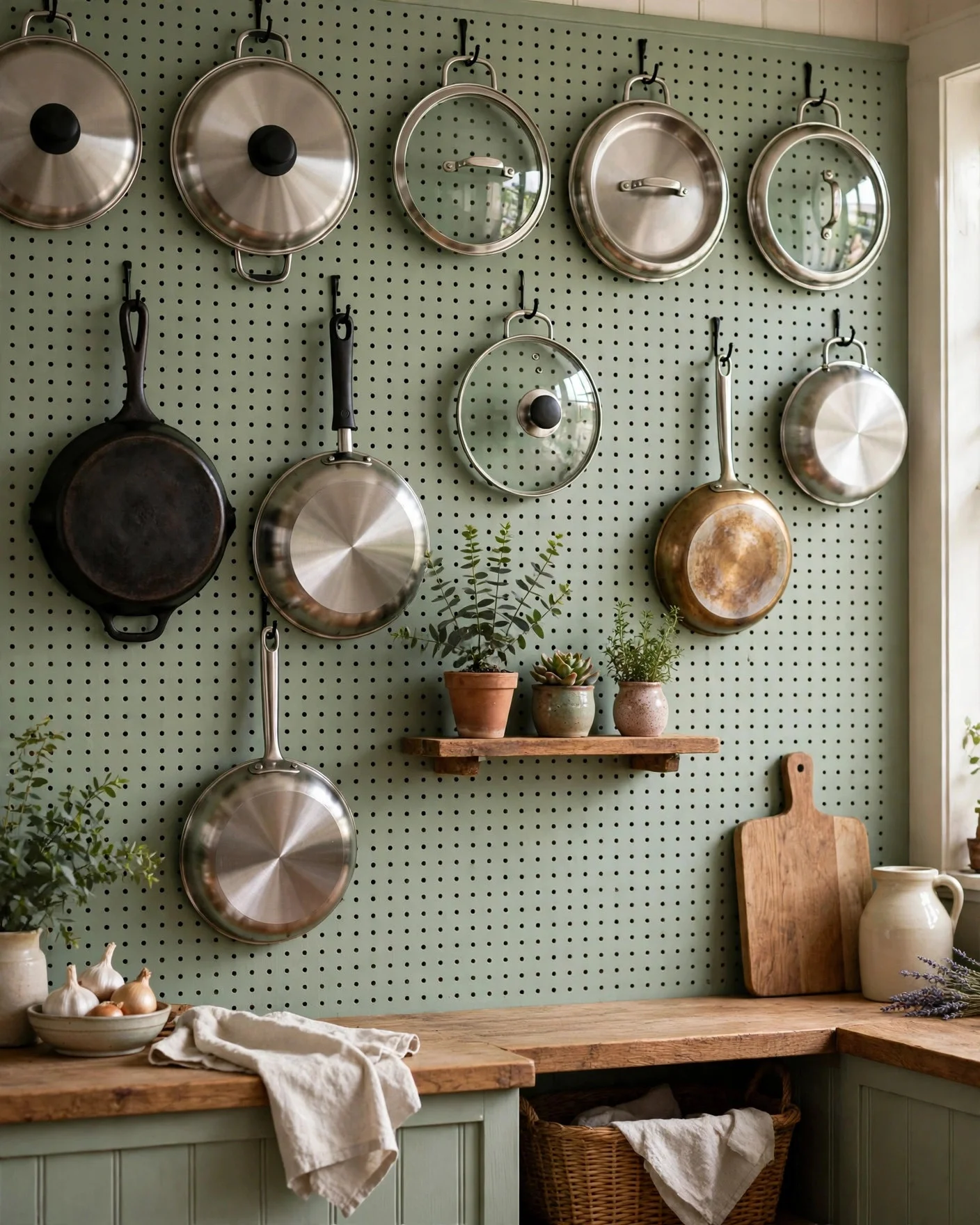
Painted sage or warm white, a pegboard turns a bare wall into a place to hang cookware. Pegs and hooks move wherever you want them, so you can reshuffle as your collection changes. Hang pans by their handles and put each lid on a small hook beside its pan. A pegboard is plain hardboard with a grid of holes, and it takes paint well.
Pegboard does not carry weight by itself. Fasten it into studs, use hooks sized for the load, and keep heavy cast iron in a low cabinet. This works best in farmhouse and open kitchens where the wall is part of the room. A pegboard wall is also wall decor, so our boho wall decor ideas can help you style the rest of that wall. Of all the pots and pans storage ideas on this list, this one puts the most cookware on show.
Top row: Lids and the lightest pans.
Eye level: Daily skillets and saucepans.
Low row: Lighter pots only.
8. Fix the Dead Corner With a Swing-Out or Lazy Susan Shelf
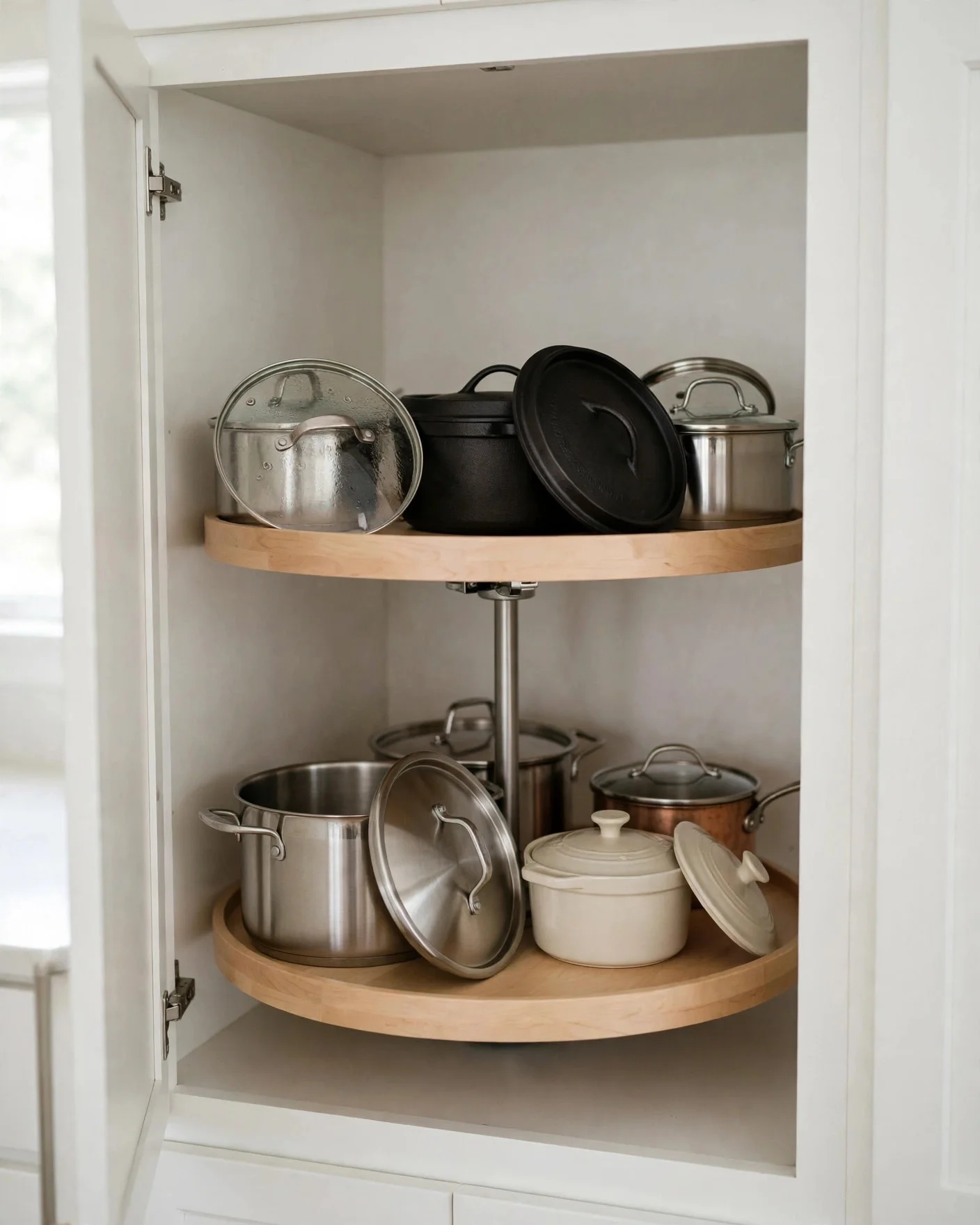
Corner cabinets hold a lot and hide even more. Two fixes work well. A Lazy Susan spins so you can reach the back with one hand. A swing-out shelf pulls the contents toward you in a curve. Either one ends the habit of crawling into the cabinet to find a lid.
Corner cabinets vary in shape and door style, so read the fit notes on the product and compare them with your cabinet before you buy. Measure the door opening too, since a shelf that cannot pass the door is no use at all.
| Lazy Susan | Swing-out shelf | |
|---|---|---|
| Reach | Spin the shelf to bring items to you. | Pull the shelf out and around the corner. |
| Cost | Usually the lower cost option. | Usually higher, with more moving parts. |
| Best for | Everyday pots and stacked lids. | Tight corners where a spinner will not fit. |
9. Store Your Heaviest Cookware in Under-Island Drawers
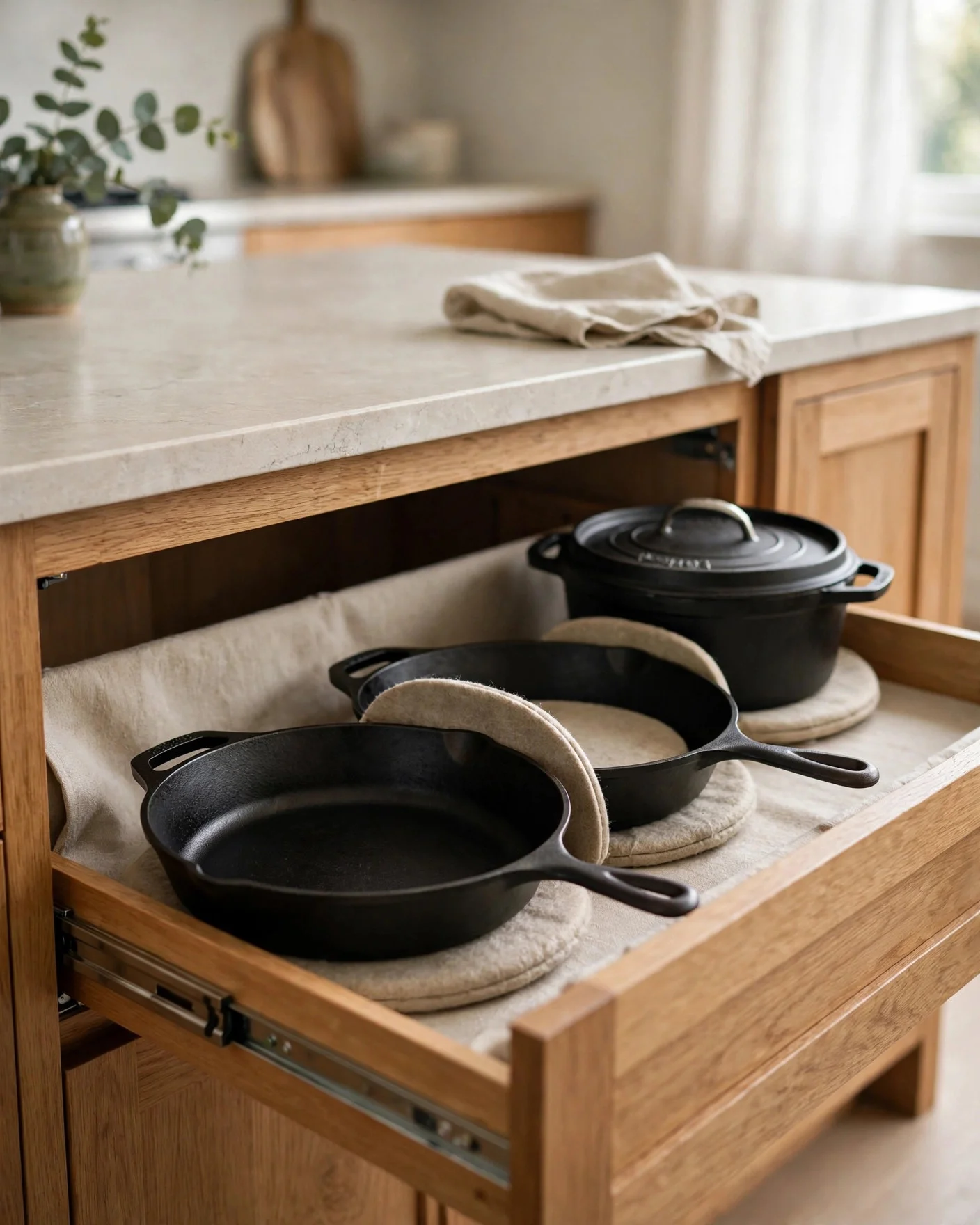
The most common mistake with cast iron is putting it up high. A roomy drawer under the island or counter keeps heavy pieces at waist height, close to the stove, and away from shelves you would have to reach over your head to use. Choose full extension slides so the drawer opens all the way, and check that they are rated for the weight inside.
Protect the pans too. Slide a soft cloth or a pan protector between stacked pieces, or give each pan its own slot so nothing scratches. This kind of cookware storage also keeps the noise down, and it is one of the kindest pots and pans storage ideas for your back.
Do this:
- Keep the heaviest pots at waist height.
- Use full extension slides rated for the load.
- Line the drawer to stop sliding and quiet the clatter.
Skip this:
- Stacking bare nonstick pans on top of each other.
- Storing cast iron on a high shelf.
- Filling a drawer past its rated weight.
10. Keep the Pots You Use Daily on Open Shelves Near the Stove
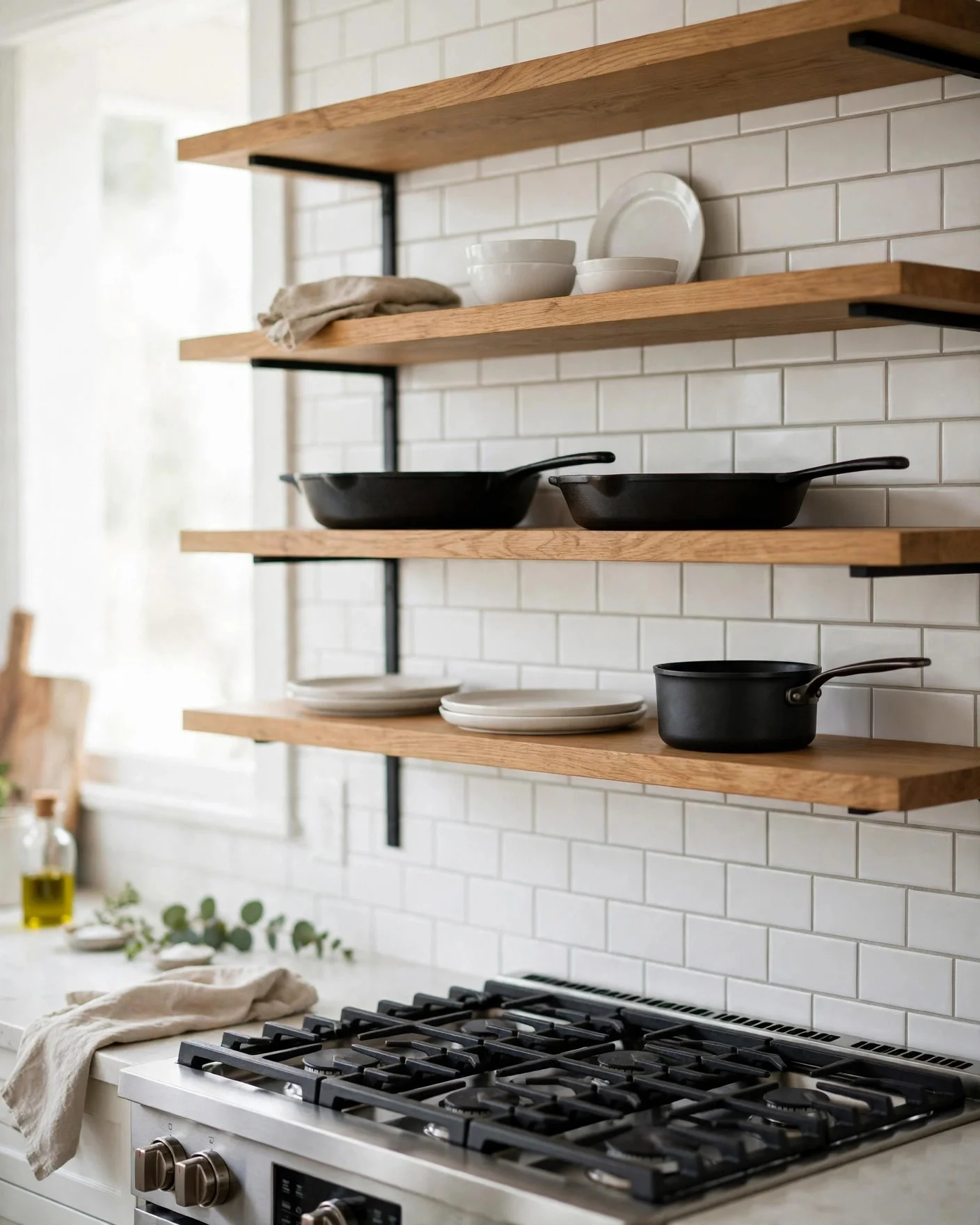
Here is a simple rule: if you use it every day, it should not hide behind a cabinet door. Open shelves near the stove work well for the two or three pots you grab most. Use a sturdy wood or metal shelf with brackets screwed into studs. Since the pots will be on display, pick pieces that sit well together. Matte black, stainless, and warm cast iron all suit modern and farmhouse kitchens.
Keep the display small. A shelf crammed with every pot turns into clutter. These pots and pans storage ideas keep daily pans where you can see them, and they are a good small kitchen trick when cabinets are already full. A small light over the shelf helps too, and our wall sconce ideas show warm, simple fixtures that suit a kitchen wall.
Good to know: Place the shelf a step away from the burners, not directly above them. Heat and splatter coat anything too close, and you will end up wiping those pots far more often.
11. Slide a Narrow Pull-Out Rack Into That Skinny Cabinet
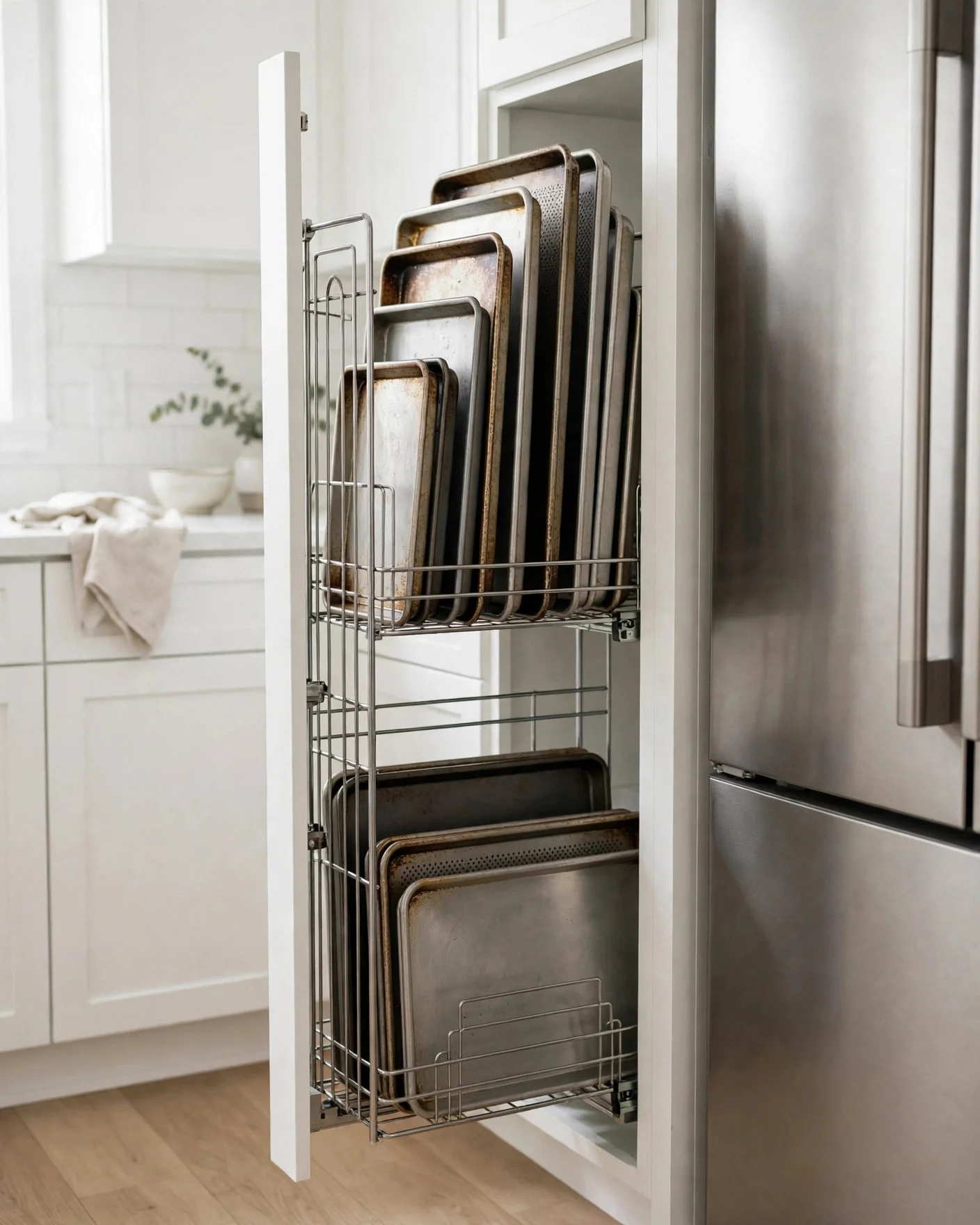
Most kitchens have one skinny gap beside the fridge or stove that holds a broom and not much else. A narrow pull-out rack turns that gap into a tall storage column for baking sheets, flat pans, and cutting boards. The frame rides on wheels or slides, so you pull it out like a drawer and see everything from the front. Pans stand on edge between the rails, which keeps them from scratching each other.
Take three measurements before you shop, and check the weight rating too, since a tall rack gets heavy once cast iron goes on it. This one suits rentals and older kitchens where custom cabinetry is not an option.
Measure before you buy:
- Width: Measure the narrowest point, with hinges and door frames that stick out.
- Depth: Measure to the back wall and note any pipes or outlets that cut into the space.
- Height: Measure from the floor to the counter or the shelf above, then subtract wheel height.
12. Give Cookware Its Own Shelf in the Pantry
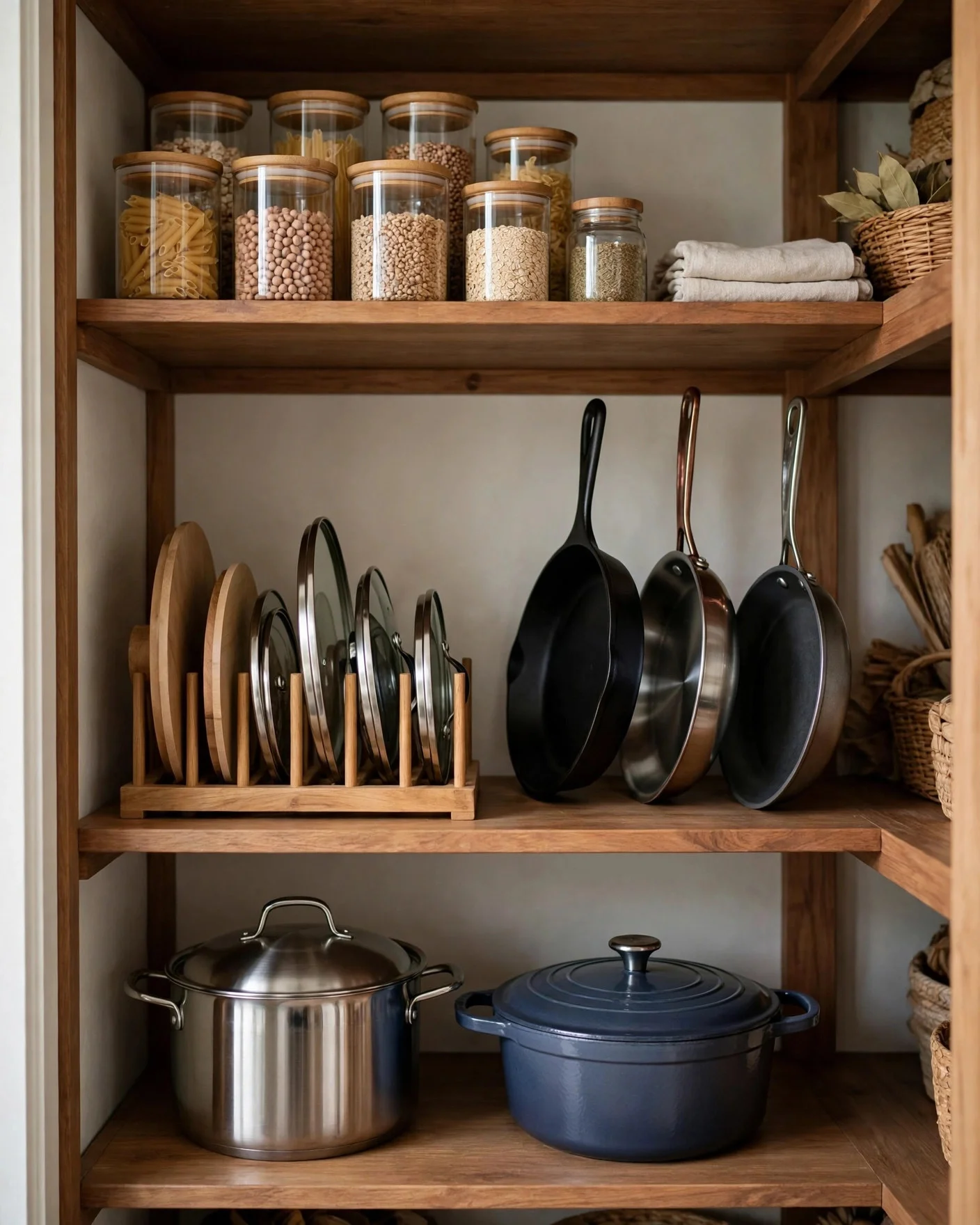
Pantries are usually planned for food, so the stockpot ends up on the floor or wedged behind the rice. Give cookware a shelf of its own instead. Tall pantry shelves handle big pots well, and a tall pantry has room for a divider rack on one side. Use the shelf closest to waist height for the heaviest pieces so you can slide them out without lifting overhead.
Check that adjustable shelves are fully seated on their pins or clips before you load them. Cast iron weighs more than it looks, and a shelf that slips can ruin a whole pantry. These pots and pans storage ideas work just as well in a pantry as they do in a cabinet.
- Top shelf: Light, rarely used pieces like a steamer basket or a spare lid.
- Eye level: Everyday skillets and saucepans, with lids on a small rack beside them.
- Waist height: Dutch oven, stockpot, and anything cast iron.
- Bottom shelf: Baking sheets on edge in a small divider.
13. Add a Freestanding Shelf When Cabinets Run Out
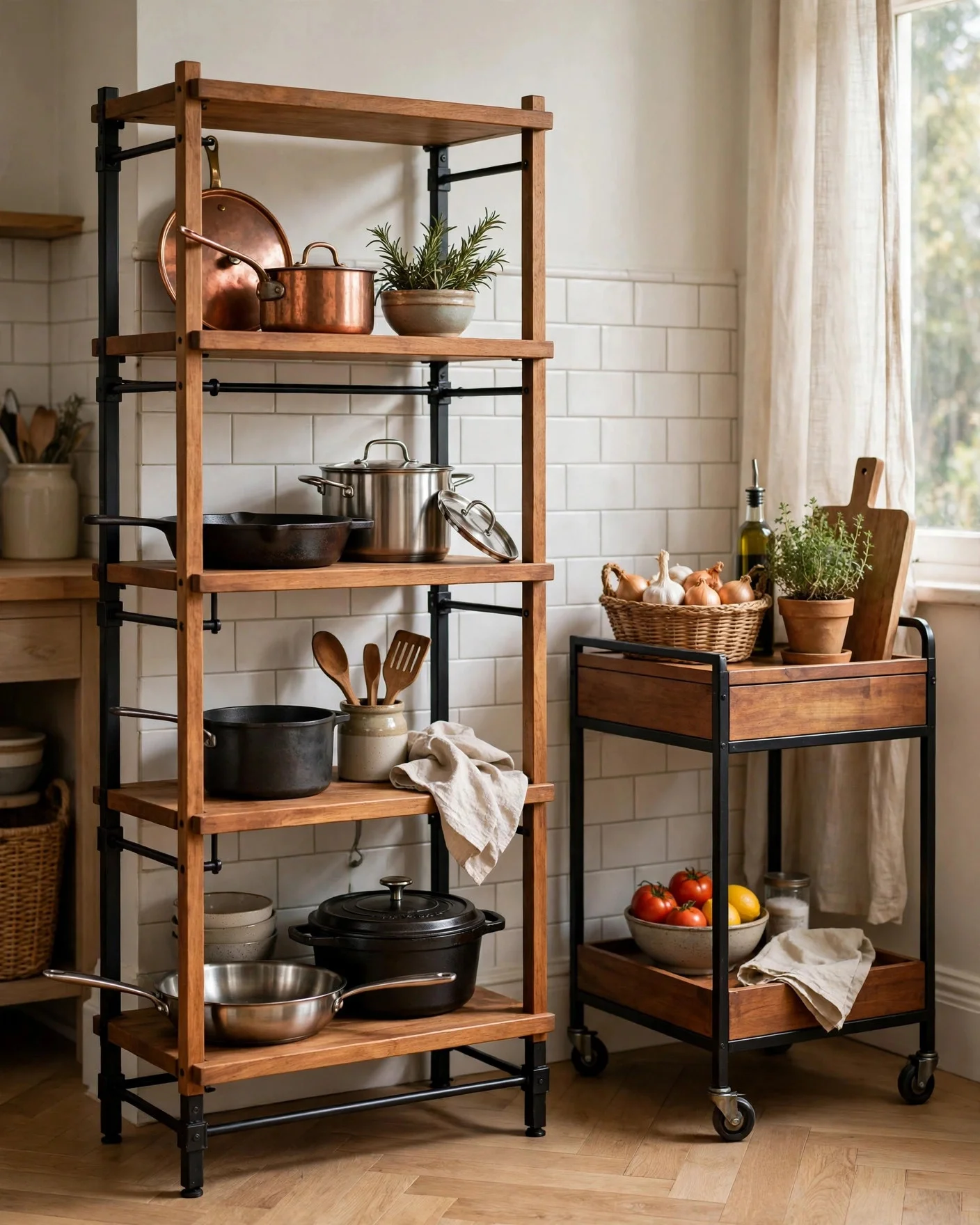
A rolling cart and a wire shelf solve the same problem in different ways, and both add cookware storage with little or no installation. Set one against a free wall, beside the fridge, or in a dining nook, and keep the pots you use most on it. In a small apartment, that adds space without touching your cabinets.
Heavy pots go on the bottom shelf. If the unit is tall, anchor it to the wall with the strap or bracket in the box, since a loaded shelf can tip. Renters can ask the landlord about one small screw hole. For more small home storage, see our apartment ideas. These pots and pans storage ideas also suit a dining nook or a spare corner that holds a cart.
- Wire shelf: Good for seeing everything at once and wiping clean fast. Watch for small pans tipping through the gaps.
- Bakers rack: Good for sturdy shelves that hold heavier pots. Watch for the extra floor space it takes up.
- Rolling cart: Good for moving cookware next to the stove while you cook. Watch for weight limits that are lower than they look.
14. Use Tension Rods to Make Lid and Pan Slots Inside a Cabinet
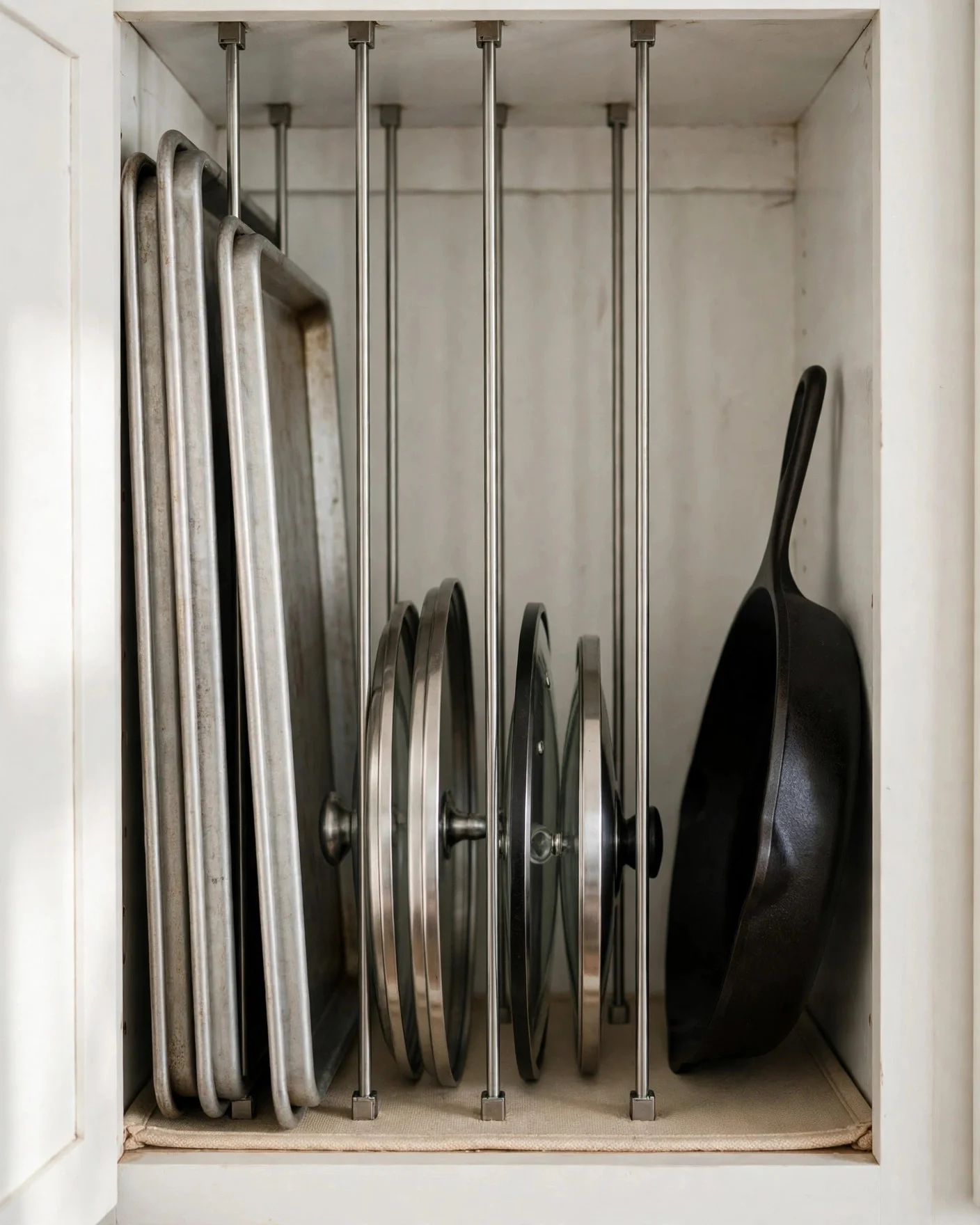
A tension rod is one of the cheapest tools on this list, and it needs no screws. Wedge rods upright between a cabinet shelf and the shelf above, and you get dividers sized to your exact cabinet. Space them to match what you store, and move them any time you buy a new pan.
- A tight pair holds baking sheets and flat lids.
- A wider gap fits a skillet.
- A rod near the front keeps things from tipping out.
Watch out: Tension rods hold by pressure, so they suit light cookware. Keep cast iron and heavy stainless on a solid shelf or in a drawer, and tug each rod firmly before you load it.
15. Set Up a Pots and Pans Storage Zone Next to the Stove
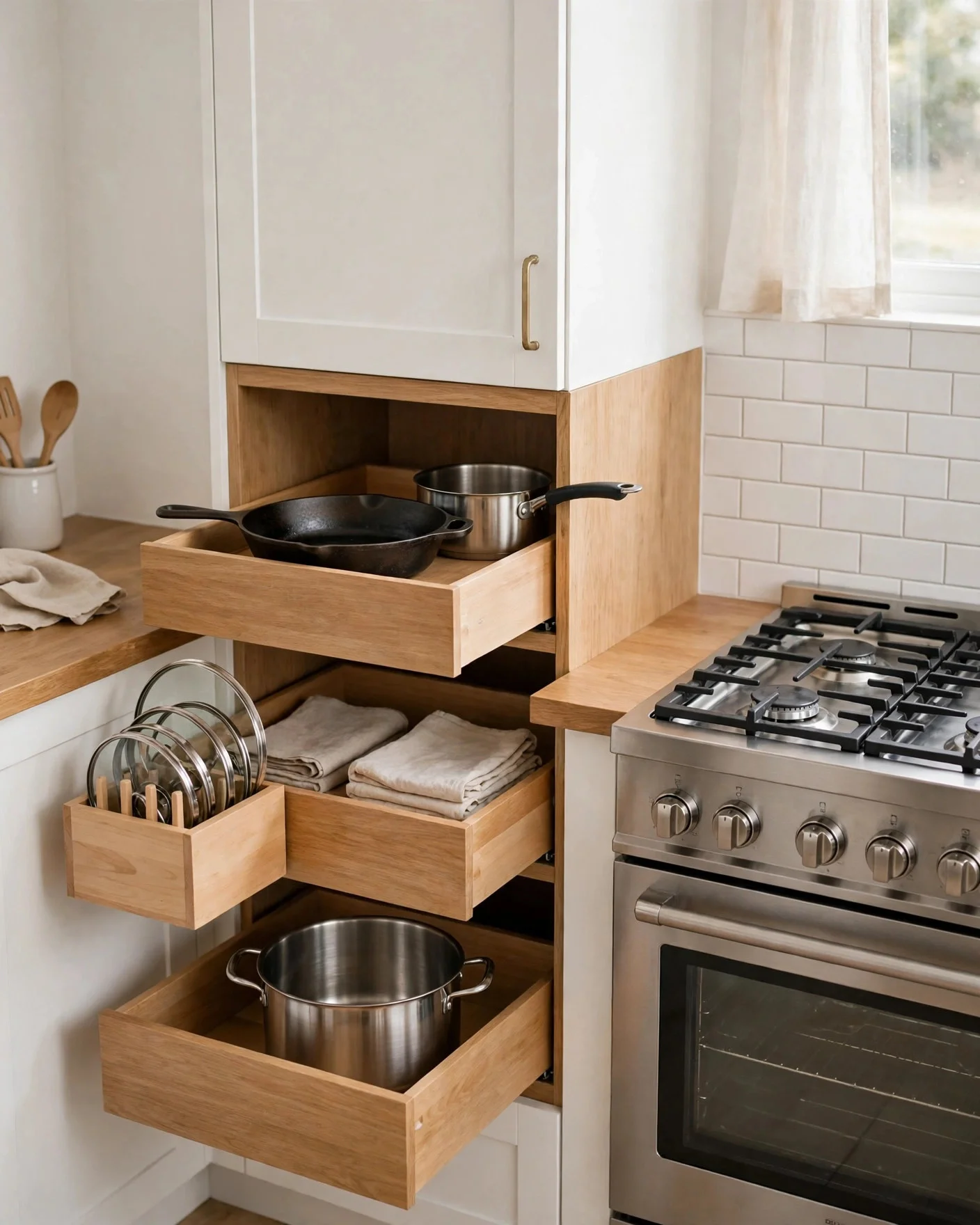
Count your steps the next time you make dinner. If you cross the kitchen for a pan, then go to another cabinet for its lid, the storage is working against you. A cookware zone puts pots, pans, and lids in the cabinet or drawer closest to the stove, in the order you reach for them. Everything else moves farther away, and this one habit makes the other pots and pans storage ideas on this list work better.
Heavy pieces go in the lowest drawer of the zone, and the daily skillet goes on top. Rarely used pieces, like the roasting pan, can live in a farther cabinet. A small lid organizer inside the same drawer keeps each pan and its lid within one reach.
Arms reach: Daily skillet, main saucepan, and their lids.
One step away: Stockpot, saute pan, and the colander.
Farther away: Roasting pan and holiday-sized pots.
How to Choose the Right Pots and Pans Storage for Your Kitchen
There is no single best answer, only the one that fits your kitchen. Start with space. Tight kitchens gain the most from vertical and hanging storage, since they use walls and doors that sit empty. Roomy cabinets and drawers suit pull-out shelves and dividers, so you never have to stack.
Then think about what you own. A set of heavy cast iron belongs low in a sturdy spot, while light nonstick pans can stand in a rack or hang. Budget and habits come last. Renters and tight budgets can start with a tension rod or a door rack, and if you cook every day, a zone next to the stove saves the most steps.
| Your situation | Lean toward | See ideas |
|---|---|---|
| Small kitchen or apartment | Vertical and wall storage that uses doors and empty walls | 2, 4, 6, 13 |
| Roomy drawers or base cabinets | Drawer dividers and pull-out shelves, so nothing stacks | 1, 3, 9 |
| Awkward corner or narrow gap | Spinning or sliding racks made for tight spaces | 8, 11 |
| Lots of heavy cookware | Low, sturdy storage at waist height or below | 3, 9, 12 |
| Renting or on a tight budget | No-drill organizers that move with you | 2, 6, 13, 14 |
| Cooking every day | A cookware zone, with daily pieces in easy reach | 4, 10, 15 |
Pots and Pans Storage Ideas: Common Questions
What is the best way to store pots and pans in a small kitchen?
Use the walls and doors first. A vertical divider rack in a cabinet, a lid rack on a door, and a wall rail free up shelf space fast. Keep only the two or three pans you use daily within easy reach, and move the rest to a pantry shelf or a freestanding rack. These pots and pans storage ideas suit rentals too, since most of them need no drilling at all.
How do I keep cast iron pans from scratching each other?
Give each pan its own slot, or slide a pan protector or a soft cloth between stacked pieces. Store cast iron low, in a roomy drawer or on a sturdy shelf, so you never lift a heavy pan over your head. Dry each piece fully before you put it away, and keep the drawer lined so nothing slides when you open it.
Should lids be stored with their pots or on their own?
On their own, in most kitchens. Lids take up little room on a door rack or in a slotted divider, and they stay easy to grab. If you keep a lid on its pot, turn it upside down so the knob does not catch the pan above it. A lid rack inside the same drawer as its pan keeps pairs together without stacking.
What is the cheapest way to organize pots and pans?
Tension rods are the cheapest fix, and they need no tools. A pair of rods makes slots for lids and baking sheets inside a cabinet you already own. A door rack for lids costs little too. Start with one of these, then add a divider rack or a pull-out shelf only if the cabinet still fights you.
How do I hang pots safely on a wall or ceiling?
Anchor every screw into a stud or a ceiling joist, never into drywall alone. Add up the weight of all the pots you plan to hang, and check that the rail, hooks, and rack are rated for that load. Keep heavy pots low and light pans up high, and keep the rack clear of the cooktop so grease does not coat your cookware.
A Calmer Cabinet Starts Small
A tidy cabinet does not need a full remodel. It needs a place for each pot, pan, and lid that fits how you cook. Start with one small change, like a tension rod or a door rack, and add more only if the kitchen fights you. These pots and pans storage ideas work when heavy pieces stay low, daily cookware stays in easy reach, and pans stop scratching each other.